Showing posts with label PROG ROCK. Show all posts

Friday, August 21, 2020

PROG SLOGS

There are occasional stirrings among those my age, music fans of a certain generation of decade, who become nostalgic for the surface noise and commotion of their own record collection and, in indulging their yen for a commodity fatally beyond its expiration date, will wax, wane and syllogize until the music of the spheres play slow blues solos some now deservedly disputably fad was, actually, not so  bad, not bad at all, in fact, pretty damn good and unfairly maligned. Beware these acolytes, lest someone try to convince you of that the true worth of progressive rock, that hyperventilated amalgam of trick pony riffs that made radio something you dreaded turning on. 

I don't buy it, for the most part. The fascination with progressive rock  grew out of the long improvisations pioneered by the essentially blues-based bands like The Butterfield Blues Band, Jimi Hendrix Experience and Cream, as the going conceit of the time was that rock and roll had become something smarter like "rock" and could now rival jazz as a young musician's medium for instrumental chops. 

The transition to classical borrowings, occasional jazz motifs and jacked up time signatures and tick-tock chord changes made for its own kind of monotony. Jazz, whatever its form or origin, was premised on the idea that, as a form, it was in a state of constant transformation--the musicians we still listen to rarely played the signature tunes the same way twice. Progressive rock, generally proud and defensive about the form's gerrymandered fussiness--this was the best place to learn the distinctions between the words "complicated" and "complex"--became insulated ever so much faster than jazz did. A one idea concept, with rare exceptions --Zappa, King Crimson, Pink Floyd--progressive rock could only become fussier, crankier, more incestuous. 

It actually became something resembling "rock" not at all, in any sense. It was the arena of sterile perfection and was truly unlistenable to a young listener having no desire (or need) to stare at the sky and ponder stoned philosophies. Punk rock was the shock rock and roll needed; stupid, obnoxious, repetitive, angry, the rude style pretty much revealed what a conceptual crock of mung progressive rock turned into. It was time to flush things away and allow the progressive rock to become something actually useful, such as fertilizer.
Friday, November 2, 2018

A HISTORY OF PROG ROCK

Image result for welcome back my friends david weigle
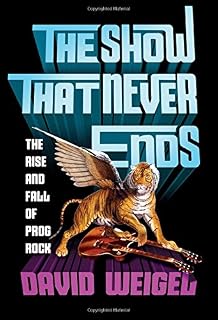
THE SHOW THAT NEVER ENDS:
THE RISE AND FALL OF PROG ROCK
By David Weigel
I was not entirely a progressive rock fan during the 70s, when the genre was at its peak and the music of the bands in this volume was at it's...busiest. I loathed the singers for the most part, thinking that while the front man had decent enough voices, suitably trained to negotiate the usually overheated song structures, I could stand them rarely a whit. Save for Peter Gabriel of Genesis (and later as a solo artist), the lot of them sounded over earnest, wide eyed with wonder, strangulated high notes offering the would-be wisdom of righteously and insanely stupid lyrics. I always had a wager with anyone who knew Wallace Stevens or John Ashbery well enough, or The Bard for that matter, would feel compelled to harm themselves to relieve the disgust that overwhelms them. 

On the other side of this genre, though, was generally good musician and an honest desire to extend rock's instrumental bearings toward more complexity. Yes, ELP, Pink Floyd, Jethro Tull, King Crimson, Genesis all moved in this direction, at best being brilliant with the snap and zip of odd time signatures, odd keys and ensemble stretches consisting of many moving parts. It was delirious, and much of the stuff remains good, cranky fun. David Weigel, a politics writer by reputation, is also a huge fan of progressive rock, and here expands on a series of fascinating articles he did for Slate some years ago on the history of this odd and painfully dated brand of music making. 

He interviews many of the musicians, he investigates the places from which they rose, and comes to consider how it was that a good many British musicians, seemingly at the same time, came to employ classical music complexity in the service of a bigger and busier kind of rock and roll. His conclusion, though not explicitly stated, is that it seems a case of the young musicians "getting back to their musical roots", of rediscovering the European classical heritage and making it their own. The book is especially fun and fascinating for the music fan who's been wanting more to be published about this under considered music. Weigel , to his weigel, does not rate the bands--re realizes that he is a reporter, not a critic--and does his subject justice by sticking with the absorbing story laid out before him.