Showing posts with label LARRY CORYELL. Show all posts

Friday, June 16, 2023

LARRY CORYELL and MICHAEL URBANIAK LIVE

I consider this a public service in posting this admittedly grainy YouTube feature of duets by two jazz masters who are beyond compare. It's a concert video of the late jazz guitar master Larry Coryell and the amazing Polish jazz-fusion violinist, originally released on VHS I believe that hasn't been released as a stand-alone disc. I pray someone will secure the rights and make it available. Coryell was a member of the original Super Guitar Trio with John McLaughlin and Paco de Lucia, and though his playing was frequently brilliant, he was often hobbled with flubs and miscues; it became obvious that LC's dependence on drugs and hooch lessened his skills, and he was replaced by the ever able Al diMeola. Coryell got clean and sober in 1981 and this effort, recorded in 1982, shows the difference. It's a remarkable performance, thanks in major portions to Urbaniak, whose skills as an improviser are second to none; his unhitched combining of styles ranging from Grapelli through Ponty and his mastery of idiom, technique and tonal nuance gives LC the colorful contrast. Urbaniak's improvisations are swift and melodic and, as with Coryell, seem without end in the configurations his long lines of notes form. Urbaniak as well, demonstrates he has a bass player's instincts and backs Coryell's ultra-virtuoso fantasias. Coryell at this time seems like a man with something to prove. Here the guitarist amply proves his point.


Wednesday, November 20, 2019

CORYELL COOKS
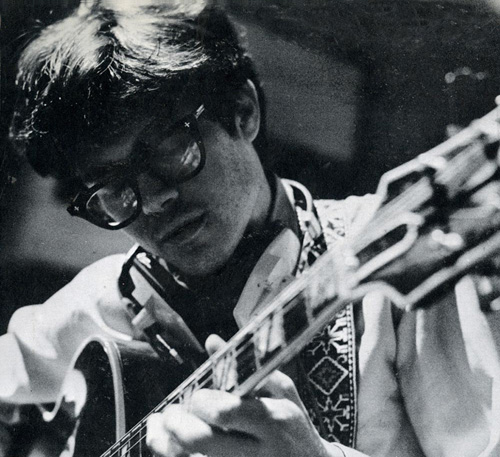
Image result for larry coryell 1974
(This was an interview I did with the late guitarist in 1974, in a Sunset Strip hotel room in Los Angeles where Coryell and his new band, The Eleventh House, were performing at the legendary Troubadour to support their debut album Introducing the Eleventh House. It's been often said since his passing that Coryell was a very nice guy, a class act, a friendly and amiable sort. Sorry, scandal seekers, no dirt here, as I can attest that the guitarist was absolutely all those things. This piece originally appeared in the San Diego Door). 
“John McLaughlin and I shouldn’t be mentioned in the same sentence,” said jazz guitarist Larry Coryell reacting to the endless comparisons between him and his British counterpart. Well meaning comparisons between Mahavishnu Orchestra and Coryell’s new band. The Eleventh House have been so relentless that a novice listener might Assume that the veteran musician is arrive late to the jazz-rock arena. Coryell shrugs and sits back in the  chair in his Sunset Strip hotel room where he’s been resting before that night’s engagement at The Troubadour in Westwood. He has an unplugged electric guitar in his hands, his fingers running through a series of nimble exercises along the frets as he speaks. The guitarist is emphatic on the distinct nature of the music of the Eleventh House.

“Similarities exist, sure,” he continues, casually scanning the swimming pool of a Sunset Strip hotel while he stifled a yawn, “but beyond that, the styles vary vastly. I’m basically a white rocker caught up in black music. Tm funky, and I like to keep a funky edge to my playing. McLaughlin hasn’t an ounce of funk in his body. I admire him an awful lot and we’re good friends, don’t get me wrong. It’s just that I think the Eleventh House is going places Mahavishnu Orchestra overlooked.”

Larry Coryell is a member of that small vanguard of jazz musicians to seriously pursued the elusive jazz rock fusion, the notable others being Miles Davis, Tony Williams, Gary Burton , with whom he played, and a number of others who broke ranks with tradition. From his days with the Gary Burton Quartet in the mid-sixties to his own series of erratic but always boldly experimental albums, Coryell has sought to fuse the hard rock immediacy to the fleet fingered ecstasy of jazz. Riffs,phrases and whole lines of blended improvisational strategies that are his creation are only now being assimilated into the lead guitarist vocabulary.Against the jazzy feel of Lawrence’s soaring trumpet soliloquies and Mandel’s elegant piano textures is the abrasive hard rock of Coryell’s guitar. He likes to start playing up the blues end of it all, then whipping out unexpectedly, some deliciously fast jazz lines. Getting faster and more complicated as the solo continues, you’re sure his fingers will burn holes in the guitar neck. His body rocks steadily on the stage, making faces with each long and mournful sustained note. Not exactly an Alice Cooper feat of showmanship, but it’s nice to see someone having a good time without breaking his neck to prove it.

“I’m the luckiest cat in the world,” said Coryell, “This band is literally bursting with ideas. Our first album was ' only a sampler of what were capable of. Alphonse, he’s got material, Mandel has material, and I’ve got some. Maybe the next album will be a double record set. Then we could really stretch out things and give everyone room.” The album. “Introducing the Eleventh House” on Vanguard has “With Larry Coryell” emblazoned under the group’s name, a necessary move on the record company’s part to help sell records. “I’m nore of a leader in name,” clarified Coryell, “I’m a central point where all this unbelievable energy is organized. Frankly, these cats are too good for me to have to ^ull any authoritarian trip. If someone ‘messes up, a cold look from me is all the reprimand needed. We communicate that well. We know exactly what’s on each other’s minds.” “I wish Vanguard would go out of their way and be a big record company for us,” he laments, revealing a disdain of corporate meddling.

Larry-Coryell is the first jazz musician to seriously pursue the elusive jazz/rock fusion
“I listen to young guys like Tommy Bolin who played on Billy Cobham’s’ album, or Bill Connors from Chick Chorea’s Return to Forever,” he reflects, “playing licks 1 created back in the mid-sixties, but adding their own ideas. Man, they turn my head around. I end up taking some of their things and sneaking it into my own playing.” He eases back in his chair, rubbing his hand through his lightly greyed black hair and adds, “Man, in a few years, these guys will burn while I’m playing cocktail jazz.” But in the meantime, Coryell thinks he’s the best at what he does, and thinks the Eleventh House is the band to bring the best out of him. Live, the band is a testimonial to high energy music. As the band assumed the minuscule Troubadour (where they’d been playing a week long, three show a night gig). Eleventh House’s technicians didn’t appear much different than the varied roadies who rushed around trying to shift equipment for each set. But once past the hassles, the band exploded in an intense kinetic fury. Playing against Coryell’s galvanic guitar was Mike Lawrence on electric trumpet and Mike Mandel on electric piano and synthesizer. Bolstered and driven on by the multi handed percussion of Alphonse Mouzon and Danny Trifan’s agile bass underpinnings, Coryell, Lawrence and Mandel would play a series of quick and complex melodies, and then spin off into individual superfast but concise solos. Then, Coryell and Lawrence would trade fours at breakneck pace while Mandel laced through it all, creating delicate patterns until the other two muted themselves and let him make a definite other worldly statement with his synthesizer. becoming known to the general record buying public. “Selling fifty thousand copies of a jazz album is respectable, but we want to sell hundreds of thousands of copies. Man, we want this band-to be known to the world, but for the music, and nothing else. It’s to our disadvantage, I suppose, that we don’t wear funny clothes, jump around on stage, or destroy our instruments. We’re naked on stage, there’s nothing else except the music, and there shouldn’t be. On a good night, we can’t be touched.”

Scratching his chin, Coryell pushed the owl framed glasses up the rim of his nose and regretfully added, “The band sounds tired. We’ve been on tour. 1 wish we could recapture the energy we had last week at the University of Paris. There, the Eleventh House’s rapid fire energy was so intense that the rhythm section broke into a musical fight. It was like going beyond racial, cultural and religious barriers and them saying to each other ‘All right motherfucker, get down,’ then driving the music to the wall and then right through it. Alphonse energized everyone, Danny pushed harder, Mike Lawrence and Mike Mandel and I were trading fours and switching eights so insanely fast that no one in the band could believe it.” He closed his eyes and picked off a fast lick on the guitar he’d been toying with. “I think Tm the luckiest cat in the world to have this group,” he restated as he stood up and took a long swig from his beer, “The communication is= fantastic. Basically, let me say, there are only two kinds of music in the world: good and bad. Eleventh House does the best music in the world.”

Wednesday, January 2, 2019

SOME FINE CORYELL JAZZ

Image result for tricycles larry coryell
It's been instructive to revisit jazz guitarist Larry Coryell after a decade or in other neighborhoods. A pioneer of jazz-fusion, this musician is, at his best, wildly inventive, cranky, blistering and rapid fire, someone akin to Jeff Beck in ways of attacking an improvisation from unexpected angles of attack. Like Beck as well, his body of work is erratic, and one wonders if Coryell might have become stuck on the fence sometime in mid-career, performing an unsatisfying amalgam of mainstream bop standards, pop-jazz, and thud - worthy, unmotivated funk and rock blends. Fortunately, age and good sense have toughened the guitarist's technique; his album Tricycles and the more recent Earthquake at the Avalon, are both superlative examples of this man's ability to display a pristine delicacy on ballads, fleet-fingered flurries on the accelerated compositions, and a hard-nosed edge on the blues. Of the two albums, Tricycles gets higher marks, as Coryell has a sweet trio in bassist Mark Egan and drummer Paul Wertico bring off a varied set of styles with the ease of a unit that knows the strengths and nuances of each other's respective approaches. Coryell's guitar bristles and casts sparks through his rich chord voicings and pristine essays, with Egan and Wertico upping the rhythmic ante and lowering it again as the major and minor turns of the songs change the mood. There is a richness in the performance that suggests a larger group. Recommended.


Wednesday, November 28, 2018

SOME LARRY CORYELL ALBUMS


Jazz encyclopedias classify the late jazz guitarist Larry Coryell’s album “Spaces” as one of the greatest fusion albums ever made, which is a mistake. Some reviewers may not have listened to the album in question. It is actually a straight-ahead set of sessions of jazz improvisations where the two creators of the jazz-rock style, Coryell and John McLaughlin, left volume and feedback behind. The album is beautifully realized, from the Coltranesque post-bop overdrive on “Renee’s Theme” to Coryell’s impressionistic “Wrong is Right”. Coryell is the hard charger here, fleet, angular, filling spaces with intricate note clusters, while McLaughlin is into spaces, silences, short lines, and beautiful bits of filigree. Bassist Miroslav Vitous is terrific, and drummer Billy Cobham works miracles throughout this excellent wash of music. This album is a mad flurry of guitar brilliance. 

Toku Du is among Coryell’s “straight-ahead” jazz albums, a 1988 set of sessions focusing on jazz standards that combine the guitarist with Stanley Cowell (piano), Buster Williams (bass), and Beaver Harris (drums). The results are academic. These tunes, such as Coltrane’s “Moment’s Notice”, Monk’s “Round 'Midnight”, and “My Funny Valentine”, get a neat, circumspect treatment that lacks guts. The guitarist approaches these “straight-ahead” projects as if he’s doing penance for past sins or trying to recover his reputation as a musician since his coke-fueled days in the waning days of fusion. Coryell improves with a later release, My Shining Hour, where he rolls up his sleeves and rages on material from Miles, Ellington, et al. The playing on the later release is liberated and exhilarating, and his band on that session swings and rocks and pulses with a verve that the present disc lacks. Coryell always bears a listen, but when he is terrible, he chews a foul root.

Not that Coryell has forgotten the jazz-rock that made his reputation in the Sixties, as we can see with Cause and Effect, which highlights the guitarist in a Tony Williams Lifetime format with keyboardist Tom Coster and former Journey drummer Steve Smith. Coryell is back in his native land, jazz-rock, and the results are prodigious, fleet, and searing. Coster and Smith, on keyboards and drums respectively, are a galvanized rhythm section that switch-hits time signatures and polyrhythms with a slamming accent. Coryell is very much at home, cutting, swift, and brilliant. Freed from the archivist’s sense of delicacy with older tunes “in the tradition”, Coryell follows his wild, sober instincts and lets the notes fly; he hasn’t been this exciting in a fusion context since his controversial work with Mingus. Fine and shredding.

It’s been instructive to revisit jazz guitarist Larry Coryell after a decade or so in other neighborhoods. A pioneer of jazz-fusion, this musician is, at his best, wildly inventive, cranky, blistering, and rapid-fire, someone akin to Jeff Beck in ways of attacking an improvisation from unexpected angles. Like Beck, his body of work is erratic, and one wonders if Coryell might have become stuck on the fence in mid-career, performing an unsatisfying amalgam of mainstream bop standards, pop-jazz, and less than worthy funk and rock blends.

Fortunately, age and good sense have toughened the guitarist’s technique; his albums Tricycles and the more recent Earthquake at the Avalon are both excellent examples of this man’s ability to display a fresh delicacy on ballads, fleet-fingered flurries on the accelerated compositions, and a hard-nosed edge on the blues. Of the two albums, Tricycles gets the higher marks, as Coryell has a sweet trio in bassist Mark Egan and drummer Paul Wertico who pull off a varied set of styles with the ease of a unit that knows the strengths and nuances of each other’s respective approaches. Coryell’s guitar fairly bristles and sparkles through his rich chord voicings and new essays, with Egan and Wertico upping the rhythmic ante.


Tuesday, November 27, 2018

JACK BRUCE AND FRIENDS LARRY CORYELL, MITCH MITCHELL and MIKE MANDEL


This recording of a live French radio broadcast of Larry Coryell (guitar), Jack Bruce (bass) and Mitch Mitchell (drums) has been circulating for years. Bruce and Mitchell were no longer with their respective former bands Cream and the Jimi Hendrix Experience (though Mitchell would rejoin JH not long after this date) and Larry Coryell, recently of the Gary Burton group, was an emerging jazz-rock pioneer who'd already released a number of albums under his own name. The audio quality is excruciatingly bad, with the muddiest sound and scratchiest ambiance imaginable. 

The sub-par fidelity may be fitting, though, or at least ironic, as the mega power trio here, winging through a selection of tunes like "Sunshine of Your Love" and such features the energy of skilled musicians jamming against the static of the spheres. This is closer in spirit and execution to the proto-grunge thrash of  1969's Emergency, the first album by the Tony  Williams Lifetime, an early fusing of fleet improvisation fury and rock's bludgeoning power. Before it became slick, polished and professional,  before it morphed into the slick and largely gutless form termed "fusion", jazz-rock was dissonant, blaring, something of a battle of hard tones and contrasts as much influenced by Ornette Coleman and free-jazz advocates. 

These were the pains of something raw and beautiful coming into being. Coryell, Bruce, and Bruce get some of that on this recording, slipshod though the presentation may be. This is of historical importance mostly, I suppose, since none of these musicians would have signed off on something this woefully recorded to be released to the public no matter how cheap it might have been priced. If you're willing to bear with the barrage, chatter, and distortion,  you'll have a sense of what might have been. Bruce and Mitchell criss-cross rhythms in ways neither of them did in their previous bands; both had jazz backgrounds and this shows a little of what they might have done. Coryell is at his choppy best, a veritable geyser of dive - bombing riffs, Quicksilver runs, thorny power chords and swaths of strategically placed feedback. He plays like a man liberated, a high tension combination of Sonny Sharrock and Albert King, with more than a little Joe Pass and Link Wray tossed in. This trudges, stumbles, energizes and rocks the box it came in. Again, the worst recording you're likely to encounter, but worth a listen.